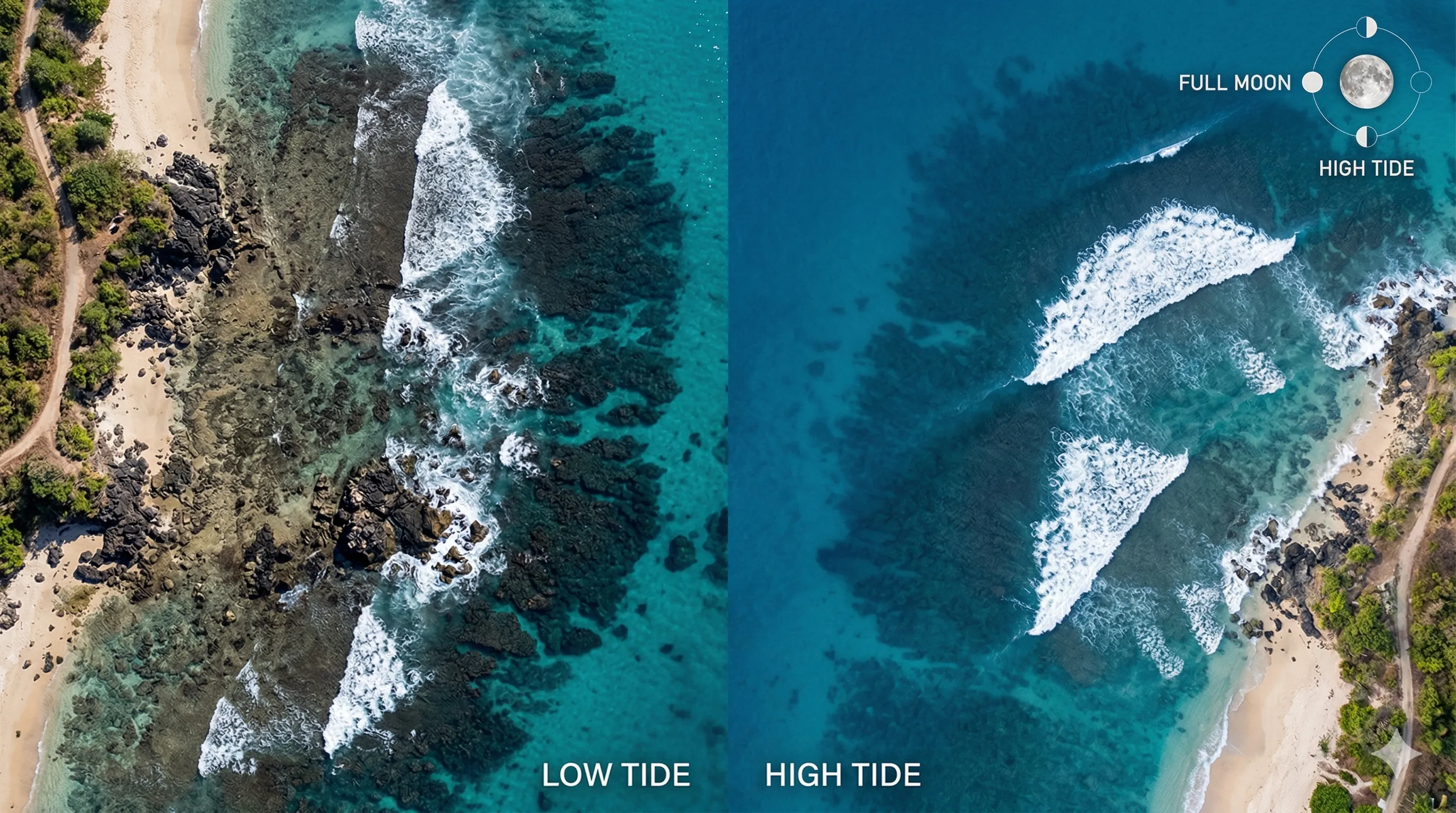
Why do tides matter for surfing?
If you've ever arrived at your favorite spot and found the waves breaking completely differently from last time, the tide was probably different. Tides are one of the most important — and most overlooked — factors when planning a surf session.
Unlike swell or wind, which can change drastically from day to day, tides are precisely predictable. This means you can know exactly when conditions will be optimal at your beach. You just need to learn to read a tide chart.
What are tides?
Tides are the periodic rise and fall of sea level, primarily caused by the gravitational pull of the Moon and, to a lesser extent, the Sun on the oceans.
Along most coastlines of Peru, Chile, Ecuador, and Colombia, there are two high tides and two low tides each day (semidiurnal tides), with a complete cycle of approximately 12 hours and 25 minutes.
Key concepts:
| Term | Meaning |
|---|---|
| High tide | Maximum water level. The sea covers more beach. |
| Low tide | Minimum water level. More seabed and rocks exposed. |
| Rising (flood) | Water is rising toward high tide. Creates onshore current. |
| Falling (ebb) | Water is dropping toward low tide. Creates offshore current. |
| Tidal range | Height difference between high and low tide. |
How to read a tide chart step by step
A tide chart shows the sea level height throughout the day, displayed as a wave-like curve. On WaveSearch, you can see the tide chart on every spot's page. Here's what to look for:
1. Identify the peaks and troughs
The peaks represent high tides and the troughs are low tides. On a typical day, you'll see two peaks and two troughs.
2. Read the times
The horizontal axis shows the hours of the day. Each peak and trough has an associated time. This is the most useful information: it tells you exactly when high and low tide will occur.
3. Read the height in meters
The vertical axis shows height in meters. Heights are measured relative to a reference level (usually the lowest mean sea level). A high tide of 1.8m and a low tide of 0.3m mean there's a 1.5m difference — a large tidal range.
4. Find the current trend
The most important thing for your session: is the tide rising, falling, or at its peak/trough? Transition hours (rising or falling) are usually the best for surfing because they generate more water movement and currents that help shape waves.
Spring tides vs neap tides
Not all tides are equal. Their intensity varies based on the Moon and Sun's positions:
Spring tides
These occur during full moon and new moon, when the Sun and Moon align. The tidal range is at its maximum: higher high tides and lower low tides. This can mean:
- Stronger currents
- Faster water level changes
- Some spots work better (more water over shallow reef breaks)
- Other spots become dangerous (intense rip currents)
Neap tides
These occur during first and last quarter moons, when the Moon and Sun form a 90° angle. The tidal range is minimal: little difference between high and low. Generally, they produce more stable and predictable conditions.
How does the tide affect different types of breaks?
This is the most valuable knowledge for a surfer. The ideal tide varies completely depending on the seabed:
Beach breaks (sandy bottom)
Examples in Peru: Cerro Azul, Señoritas, Huanchaco, Mollendo
Beach breaks generally work best at mid to low tide. At very high tide, waves lose power because they break over deeper water. At very low tide, they may break too close to shore or directly onto the sand.
Best time: 2-3 hours after high tide (dropping) until 1 hour before low tide.
Reef breaks and point breaks (rocky bottom)
Examples in Peru: Punta Rocas, La Herradura, Pico Alto, Cabo Blanco
These spots need enough water over the rocks to be surfable. They generally work best at mid to high tide. At very low tide, rocks are exposed and surfing can be dangerous.
Best time: From 2 hours before high tide until 1 hour after.
Mixed spots
Examples: Punta Roquitas, Makaha, Barranquito
Many Lima spots have a rocky bottom with sandy sections. In these cases, experimenting with different tides is key. A good trick: arrive at the beach 3 hours before high tide and surf through the entire rise — you'll see how the wave changes and can identify the best window.
Ideal tides for popular Peru surf spots
| Spot | Bottom type | Best tide | Avoid |
|---|---|---|---|
| Punta Rocas | Reef/Point | Mid rising to high | Low tide (exposed rocks) |
| Pico Alto | Reef | Mid to high | Low tide (very dangerous) |
| Chicama | Point | Mid to high | Extreme low tide |
| Punta Roquitas | Point/Rock | Mid rising | Low tide (shallow) |
| Makaha | Reef | Mid to high | Low tide |
| Señoritas | Beach/Rock | Mid to low | Extreme high tide |
| Cerro Azul | Point/Sand | Mid | Extreme tides |
| La Herradura | Point/Reef | Mid to high | Low tide |
| Barranquito | Rock/Sand | Mid rising | Low tide (currents) |
| San Bartolo | Beach | Mid to low | High tide (loses shape) |
Common mistakes when reading tides
1. Thinking high tide = bigger waves
Tides don't control wave size — that depends on the swell. Tides affect how and where waves break. A high tide can make a spot work better or worse, depending on the bottom type.
2. Ignoring the tidal range
A high tide of 0.8m is very different from one of 1.5m. On spring tide days (full/new moon), changes are more drastic and you should take this into account.
3. Not considering the trend
The same level of 0.7m can produce different waves if the tide is rising (more current, more powerful wave) vs falling (less current, slower wave). The transition matters as much as the level.
How to use tides on WaveSearch
On each spot page at WaveSearch you'll find:
- Tide chart: visual graph with high and low tide times
- Moon phase indicator: to anticipate spring or neap tides
- Combined forecast: swell + wind + tides together for the complete picture
The trick is to combine tide information with swell and wind data. A perfect 1.5m swell can be wasted if you arrive at the wrong tide. Check the full forecast before every session.
Quick summary
- Tides are predictable — use them to your advantage
- Beach breaks: best at mid-low tide
- Reef/point breaks: best at mid-high tide
- Transitions (rising/falling) are usually better than extremes
- Full and new moon = spring tides (more range)
- Always combine tides + swell + wind for your final decision