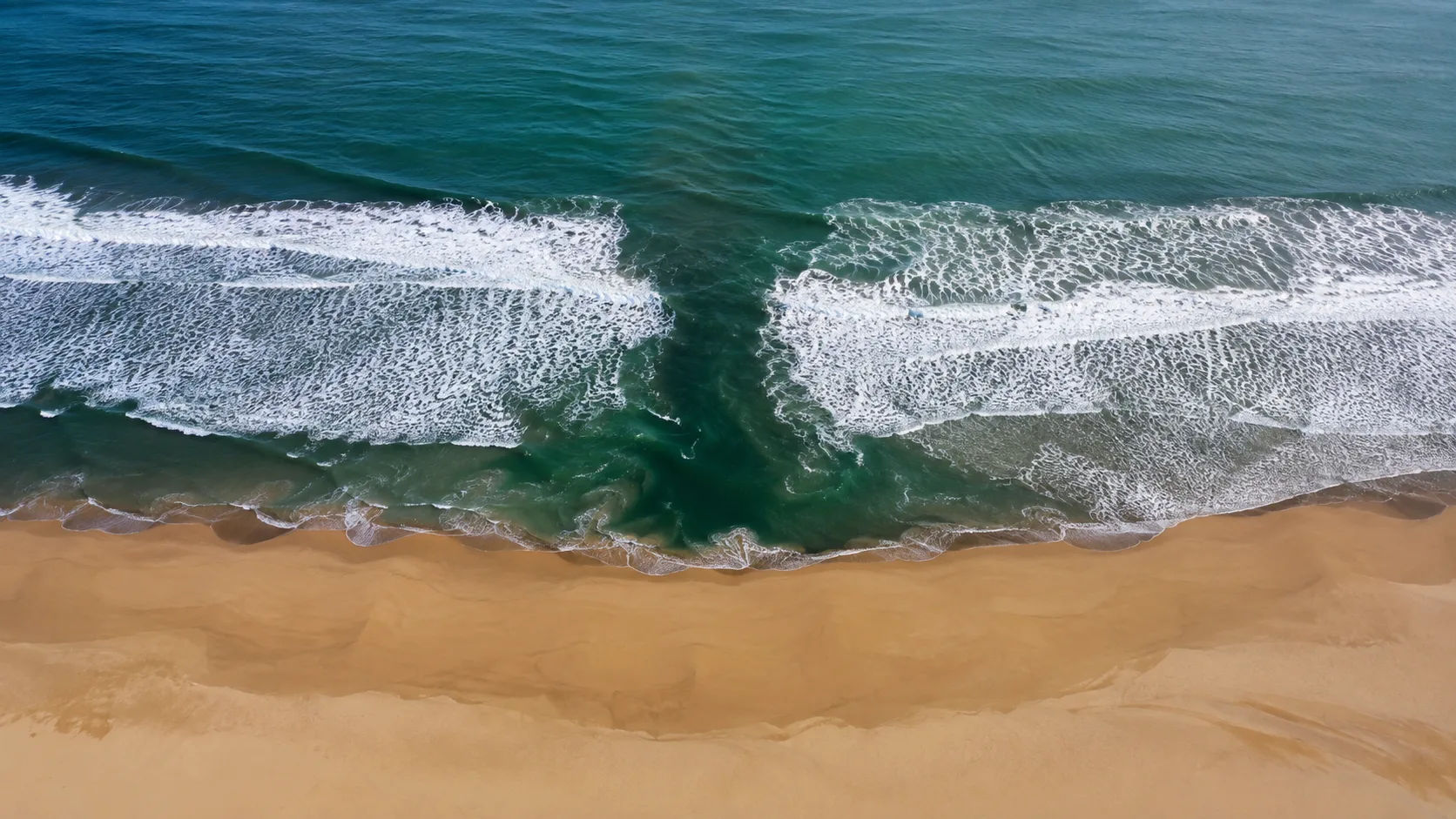
Peruvian surfers call them "chiras". The manuals call them rip currents, and they are the number one silent danger on our beaches: narrow channels of water flowing from the shore out to sea, capable of dragging a swimmer away in seconds. Peru's National Police lifeguard unit performed more than 1,500 ocean rescues during 2025, and its own commanders point to strong currents as a leading cause, along with alcohol. Knowing how to recognize them and react properly can save your life, and if you surf, it can even save you paddling energy.
What a rip current is
When waves break and push water toward the beach, that water has to return to the sea. It does so through the path of least resistance: a deeper channel between sandbars, next to a pier or a rocky point. A river forms inside the ocean, running against the incoming waves.
The numbers explain the danger. According to NOAA, a rip current can reach 2.4 meters per second, faster than an Olympic swimmer. Peruvian oceanographer Gino Passalacqua describes average speeds of 2 km/h reaching 8-10 km/h in extreme cases, with channels from a few meters to several hundred meters wide. In the United States, where statistics are better broken down, USLA and NOAA estimate that 80% of rescues on surf beaches are due to rip currents. Peru does not publish an official breakdown by cause, but lifeguard reports point in the same direction.
How to spot one from the beach
Before entering the water, spend two minutes reading the ocean, ideally from a high point (a boardwalk, a dune, the lifeguard tower). Look for:
- A gap in the wave pattern: a strip where waves do not break while they do on both sides. That inviting "calm lane" is precisely the current's channel.
- Water of a different color: the channel is deeper and looks darker than the surrounding water.
- Foam, seaweed or sediment moving steadily out to sea, like a conveyor belt.
- Choppy, churning water in a narrow strip perpendicular to the beach.
Chiras are especially common near piers and rocky points, and they intensify on anomalous swell days, when Peru's Navy hydrography office (DHN) issues special advisories. In 2026 these episodes have been recurrent: massive port closures in March (around 90), April (53) and this June, with over 100 at the peak of the latest swell, and with the Coastal El Niño intensifying the ocean will keep delivering surprises. Always check the flag of the day: green means safe, yellow means caution, red means do not enter.
If it catches you: the golden rule
First thing to understand: the current pulls you out to sea, it does not pull you under. People drown from exhausting themselves fighting it, not because the channel sinks them. Therefore:
- Do not swim against the current. It is a losing battle even for strong swimmers.
- Swim parallel to the shore. The channel is narrow; a few meters sideways is usually enough to exit it and ride the waves back in.
- If you cannot get out, float. Stay calm, save energy and let the current weaken offshore; then swim diagonally back to the beach.
- Call for help early. Wave your arms and shout toward the tower. Peru's police recommend swimming only during lifeguard hours (9:00 to 18:00) and never at night or after drinking alcohol.
Real cases, real lessons
Recent seasons left painful examples and remarkable rescues. In January 2025, on a single day and with the red flag up, lifeguards in northern Peru rescued a 19 year old surfer dragged 700 meters out to sea in Máncora and a teenager caught in a rip current 150 meters from shore in Vichayito. In November 2024, three people swept out by anomalous swell at El Silencio (Punta Hermosa) had to be rescued by helicopter. And Lima's beaches with the most rescues in January 2025 were Santa María del Mar, San Pedro de Lurín, Punta Negra, Arica and Cerro Azul: none of them exotic, all of them everyday weekend beaches.
For surfers: the chira as an ally (with respect)
Here is the paradox every surfer learns: the same channel that terrifies swimmers is the elevator to the lineup. Experienced surfers read the current and paddle out through the channel, where fewer waves break, reaching the peak with half the effort. But that tool demands judgment:
- Never let go of your board. It is your flotation device; with a leash and a board, a rip is a ride, not an emergency.
- Do not use it at unfamiliar spots or on days above your level: you do not know where the channel deposits you.
- If it surprises you, climb on your board and wait. The current dies offshore; from there, paddle back in at an angle.
- Beginners: stay out of the channel. Until you master reading the ocean, enter and exit where the waves break, with lifeguards in sight.
Checklist before paddling out
- Watch the ocean for 2 minutes from a high point and locate the channels.
- Respect the flag of the day and lifeguard hours.
- Check the forecast and DHN swell advisories on your spot's WaveSearch page.
- Pick a fixed reference point on the beach to notice if the sea is moving you.
- When in doubt, do not go in. The ocean will still be there tomorrow.
Sources: PNP lifeguard unit (2024-2026 reports via Andina, El Comercio and Infobae), NOAA Ocean Service and Ocean Today, USLA, DHN (special swell advisories) and cases documented by Peruvian press, verified as of June 15, 2026.