Why this update matters right now
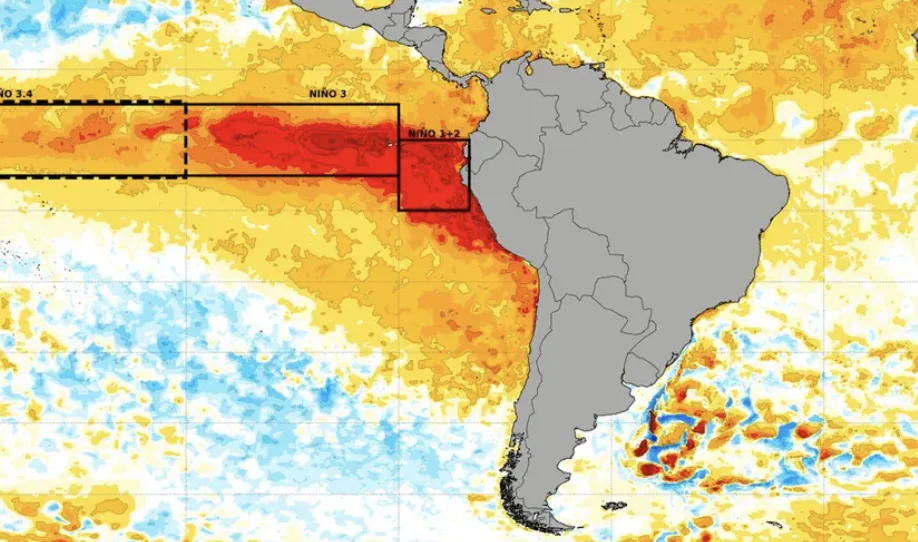
In April we published our Coastal El Niño April 2026 update, when ENFEN extended the alert through January 2027 and an anomalous swell closed dozens of ports. Two months later the picture has escalated: ENFEN declared the event has entered a moderate magnitude phase, extended the alert through February 2027, IMARPE detected subsurface anomalies of up to 7-8°C off Paita, and a new anomalous swell event keeps 78 ports closed through June 11. We're now inside the southern surf season, and the oceanographic context is the most active of the year.
What's new: ENFEN No. 10-2026 declares a moderate phase and extends the alert to February 2027
ENFEN Official Communiqué No. 10-2026, issued on May 29, marks a phase change from the April forecast:
- Moderate phase: ENFEN reports that Coastal El Niño is intensifying toward moderate magnitude, a scenario expected to hold at least through August 2026.
- Extended duration: the event would last through February 2027 (in April the horizon was January 2027), though with lower intensity in the final stage.
- Global El Niño developing: ENFEN foresees the development of an El Niño in the central equatorial Pacific between June 2026 and February 2027, overlapping with the local coastal event.
The next official communiqué was scheduled for June 15, 2026. We recommend following it at enfen.imarpe.gob.pe.
Sea temperatures: subsurface anomalies up to 7-8°C off Paita
June's strongest signal is below the surface. IMARPE reports:
- Subsurface layer off Paita: thermal anomalies of up to 7°C above normal, with sectors reaching 8°C off Paita and Chicama.
- Sea surface: anomalies near 4°C above average in several sectors, with points exceeding the historical average by up to 5°C.
- Between Chimbote and Chicama: 2-3°C above normal at 80 meters depth.
- General coastal anomaly: currently between +1 and +1.5°C, projected to exceed +2°C toward the start of winter.
The warming is driven by incoming warm Kelvin waves (three during May, with one or two more expected in June). ENFEN also notes a cold Kelvin wave between June and July that could partially attenuate the warming; worth tracking the communiqués to see if it materializes.
Active anomalous swell: 78 ports closed through June 11
The Hydrography and Navigation Directorate (DHN) of the Peruvian Navy issued a special notice for anomalous swells valid through June 11, 2026. It's the most extensive event since April:
- 78 ports closed nationwide, after climbing from 46 within hours.
- Most critical days: June 7 and 8, with strong-intensity swell —coinciding with the election weekend—.
- Southern coast the most affected this time (in April the focus was center-south).
- SW swell, generated by the weakening of the South Pacific anticyclone and the entry of subpolar winds.
For surfers, this means powerful SW swells hitting the southern and central coast hard. It's real southern-season energy, but at an intensity that closes ports: big waves and strong currents that demand respect, especially on June 7 and 8.
Global El Niño: the transition that was 61% in April is now confirming
The biggest change from April is in the equatorial Pacific. What was a 61% probability then is now materializing:
- NOAA (Climate Prediction Center): ~82% probability of global El Niño in the May-July 2026 quarter.
- WMO (World Meteorological Organization): 80% probability of El Niño between June and August, rising to 90% or more toward November.
- Northern Hemisphere winter 2026-27: up to 96% probability of El Niño between December and February.
The combination of a Coastal El Niño in a moderate phase and an emerging global El Niño is exactly the scenario we anticipated in April, and it reinforces the expectation of sustained temperature, rainfall and swell anomalies in the second half of the year.
What does this mean for the 2026 southern season?
We're now inside the southern season (May-October), which depends on extratropical storms in the South Pacific. June's context reinforces what we flagged earlier:
- Considerably warmer water than usual: with surface anomalies of several degrees, the typical cold of Humboldt upwelling is dampened. Many surfers are wearing one step less neoprene than they would in mid-winter, though the difference between dawn and midday is marked.
- More frequent and intense anomalous swells: June's event is stronger than April's and hits the south harder. Expect repeats during winter.
- No structural alteration of southern swells: the storms that generate big waves are at 40-60°S latitudes and aren't directly affected by Coastal El Niño. Pico Alto, Punta Rocas and La Herradura will keep receiving their swells.
- More unstable coastal atmosphere: more frequent onshore winds, more morning fog and heavier-than-normal drizzle (garúa).
Safety recommendations for surfers
With the active anomalous swell (peaks June 7-8, valid through June 11) and during the moderate-magnitude months (through August):
- Check the DHN notice before every session: dhn.mil.pe/portal/avisos-especiales. The Navy recommends avoiding recreational and sporting activities near the sea while the alert is in effect.
- Take extra care on June 7 and 8: these are the highest-intensity days, especially on the southern coast.
- Intensified rip currents: long-period swells generate stronger rip currents, especially at beach-breaks (Punta Hermosa, San Bartolo, Pampilla).
- Don't underestimate normally calm spots: during anomalous swell events, La Herradura, Makaha and Cerro Azul can double their usual size.
- Surf with a buddy and let someone on land know, especially at rock spots like Punta Roquitas or La Pampilla.
- Check the forecast at wavesearch.pro: we monitor wave height, period and swell direction with Open-Meteo and Copernicus data updated hourly.
Updated 2026 timeline
This is the official ENFEN communiqué timeline during 2026:
- Jan 16: Coastal El Niño watch.
- Feb 13: Coastal El Niño alert — weak magnitude through November.
- Mar 3: confirmation of initial phase.
- Mar 14: alert extended through December 2026, possible moderate magnitude in autumn.
- Apr 16: alert extended through January 2027, possible moderate Jun-Jul.
- May 29: Communiqué No. 10-2026 — moderate phase, alert extended through February 2027 and global El Niño development.
- Jun 15: next official communiqué scheduled.
Conclusion
Coastal El Niño 2026 went from "possible moderate" to declared moderate, now extends through February 2027, and a global El Niño is confirming on the horizon. For the Peruvian surfer, the southern season opens with powerful swells and noticeably warmer water, but also with an anomalous swell that closes ports and demands caution. The winter 2026 rule: good waves, warm water, and attention to DHN notices and ENFEN communiqués.
For prior context, read our April update and the complete guide to Coastal El Niño 2026.
Sources
- ENFEN — Official Communiqué No. 10-2026 (May 29, 2026).
- IMARPE — subsurface thermal anomaly reports (May-June 2026).
- DHN-Peruvian Navy — special notice for anomalous swells (valid through June 11, 2026).
- NOAA Climate Prediction Center — ENSO Diagnostic Discussion (June 2026).
- World Meteorological Organization (WMO) — El Niño/La Niña Update (2026).
- Infobae Perú, El Comercio, La República, TV Perú (May-June 2026).