If Chicama is Peru's most famous wave, Pacasmayo is its big sister: larger, more consistent on solid swells and with far fewer people in the water. This left pointbreak in front of the Pacasmayo lighthouse, in La Libertad, delivers rides that exceed one kilometer on a normal day, and on exceptional swells connects sections for entire minutes. Here is the complete guide to plan your trip.
The wave: El Faro
Pacasmayo's main wave breaks in front of the lighthouse, north of town, over a mixed bottom of sand and rock. The take-off starts with a fast section that runs past an old stranded ship and then opens into a long left wall running toward the pier, alternating steeper sections with softer stretches, ideal for linking maneuvers or simply enjoying the line.
- Type: left pointbreak, typical rides of 1 to 1.5 km.
- Ideal swell: south and southwest (S-SW) groundswell. It is a swell magnet: it works from about two feet and holds waves well overhead.
- Tide: low to mid, according to most references.
- Wind: clean or glassy mornings; in the afternoon a strong, steady south wind of 12 to 22 knots kicks in.
- Level: intermediate and up. With size it demands paddling fitness and line reading; the paddle back to the peak is long.
- Crowd: low for the quality of the wave. Even with a good swell it is common to surf with just a handful of people.
On exceptional days, with a south swell around 12 feet, the wave connects from the lighthouse to near the pier: rides of roughly 2.5 km that have been timed at about 4 minutes. It is not the norm, but it is the kind of day that made Pacasmayo a legend.
Pacasmayo vs Chicama: which one?
They are about 68 km apart by road (around one hour between Pacasmayo and Puerto Malabrigo), so the short answer is: both. But the differences matter:
- Size: Pacasmayo is almost always bigger. Its point catches more swell and holds far more size than Chicama.
- Length: Chicama is the longer total ride, but it sections; Pacasmayo connects its sections better.
- On small swells: Chicama is usually the better call. On solid swells, Pacasmayo shines.
- Vibe: both mellow compared to any famous point in the world.
Getting there
- Pacasmayo sits at km 681 of the Panamericana Norte, roughly halfway between Trujillo and Chiclayo.
- From Trujillo: about 110 km, roughly 1.5 hours on the highway.
- From Chiclayo: a similar distance southbound, also around 1.5 hours. Both cities have airports with flights from Lima.
- From Lima overland: about 670 km, around 10 hours by bus, with daily departures from several companies.
When to go
The south swell season runs from April to October: that is when the point receives the groundswell trains generated in the South Pacific and the wave shows its best version. From December to March the ocean drops in size and the spot becomes friendly for beginner and intermediate levels.
The water is normally cold: around 14 to 16 °C in winter (4/3 wetsuit) and up to 20 °C in summer. 2026 is the exception: with the Coastal El Niño warming the coast, the water is running several degrees above normal for winter. Check the current water temperature and forecast on the spot's WaveSearch page before packing your wetsuit.
One key daily-rhythm fact: surf early. The pattern runs like clockwork: orderly mornings, then strong south wind in the afternoon. That same wind turned Pacasmayo into a world class kitesurfing destination, promoted as the longest kiteable wave in the world. The coexistence is natural: surfboards at dawn, kites after lunch.
Where to stay and what else to do
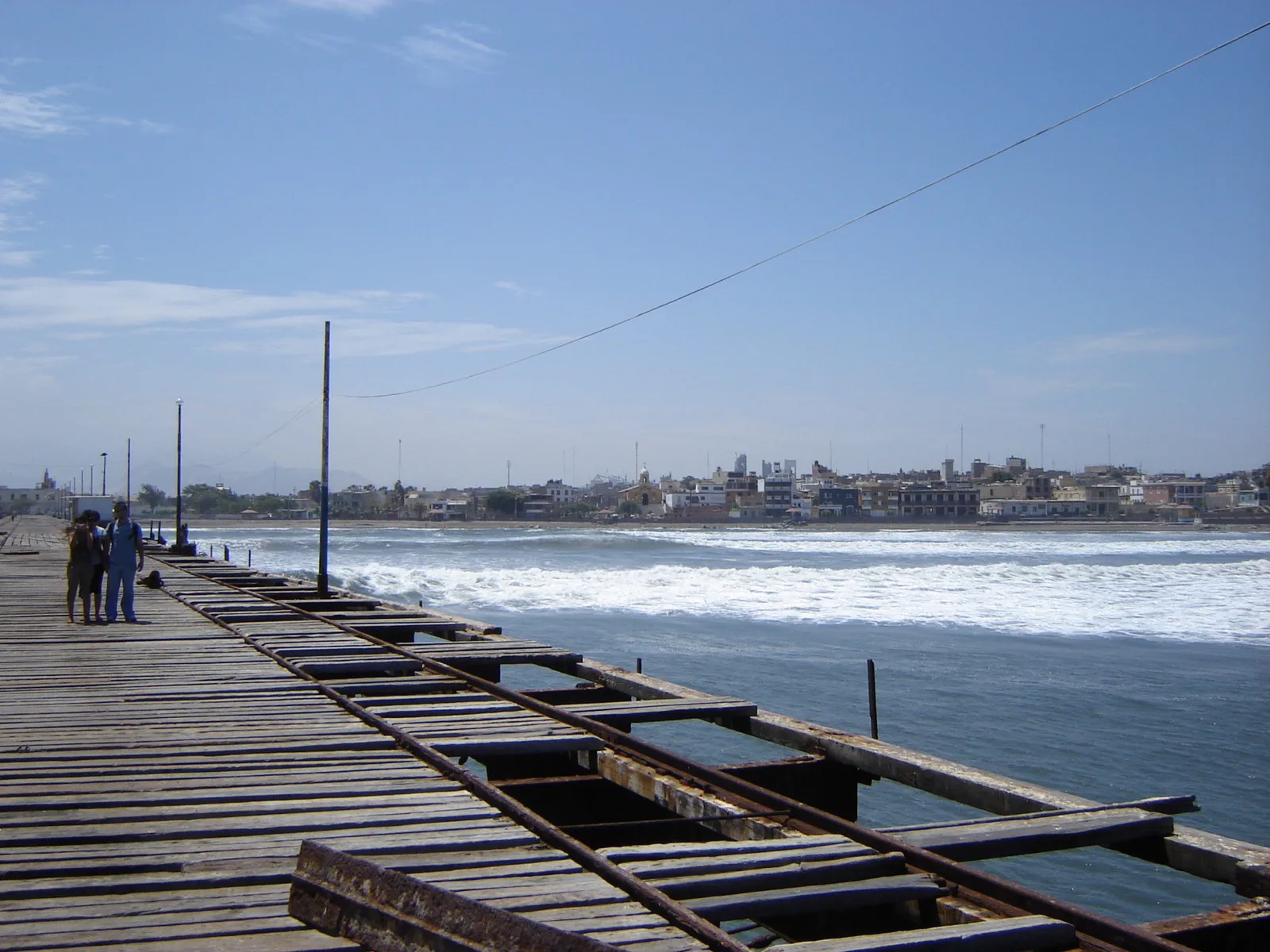
Right in front of the point sits El Faro Adventure Resort, the classic lodging for surfers and kiters, and at Puemape beach (about 20 minutes south) there are surf camp options. The town of Pacasmayo has hotels, restaurants and one of the prettiest postcards in northern Peru: its historic pier, started in the 1870s, which once measured 773 meters and today preserves 544. It is a Historic Monument and part of the nation's Cultural Heritage, although anomalous swells have battered it in recent years; it is worth a sunset visit.
If you have extra days, Puemape offers a hollower, more powerful left point between Pacasmayo and Chicama. Same rule as home: go early, before the wind.
A town with surf history
Pacasmayo is no recent discovery. The Pakatnamú Surf Club was founded here in January 1971 and seeded the first championships of northern Peru. The tradition lives on: FENTA's National Surf Circuit has held stops on this wave, and the 2020 Pacasmayo Classic made history with its perfect lefts and its spirit: every participant received the same prize, a piece of local art. Miguel Tudela summed it up calling them "the best waves I have ever surfed".
Quick checklist
- S-SW swell of 5 feet or more: Pacasmayo turns on.
- Morning session, always.
- Low to mid tide as a starting point.
- A board with volume or a step-up: long rides punish your legs.
- Updated forecast, tide and water temperature on the spot's WaveSearch page.
Cover photo: Pacasmayo historic pier, by Guillermo Arévalo Aucahuasi (Wikimedia Commons, CC BY-SA 4.0 license).