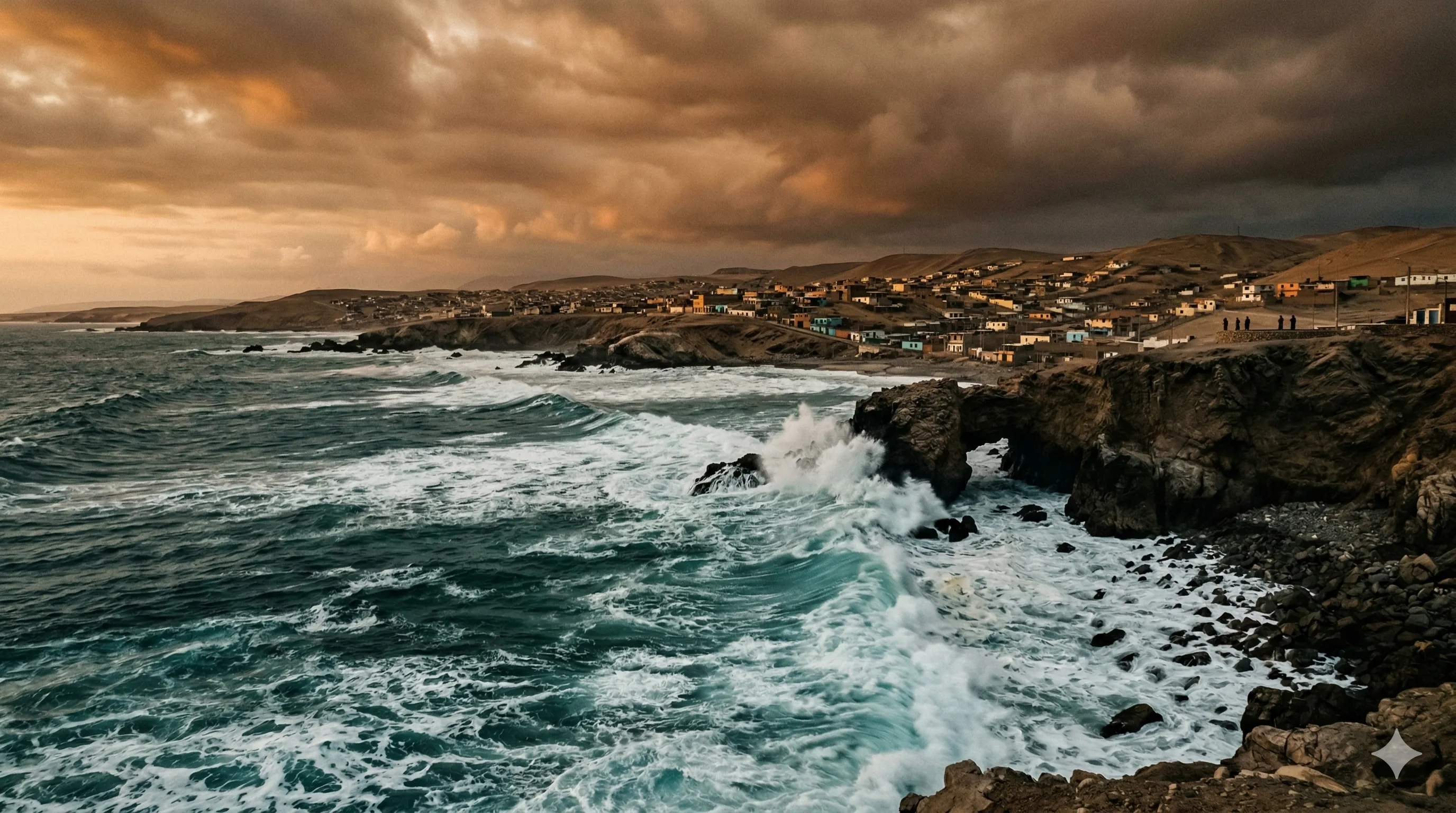
What is El Niño Costero?
El Niño Costero is an oceanographic phenomenon that occurs when the sea surface temperature (SST) off the Peruvian coast rises more than 0.5°C above its historical average for at least three consecutive months. Unlike the global El Niño (which spans the entire equatorial Pacific), El Niño Costero is concentrated along the coastal strip of Peru and Ecuador, profoundly altering sea conditions, climate, and, of course, waves.
Official timeline of El Niño Costero 2026
The ENFEN (National Study Committee for El Niño), a multi-sector body comprising IMARPE, Senamhi, DHN, IGP, ANA, and INDECI, has closely monitored this event's evolution:
- November 18, 2025 — Statement N° 12-2025: Alert system declared as "Not active" until March 2026.
- January 16, 2026 — Statement N° 01-2026: Changed to "El Niño Costero Watch". Probability of weak warm conditions detected from April.
- January 30, 2026 — Statement N° 02-2026: Watch maintained. Weak warm conditions more probable from March, persisting until at least October.
- February 13, 2026 — Statement N° 03-2026: Status elevated to "El Niño Costero Alert". Weak magnitude event projected from March to November, with possibility of reaching moderate magnitude in July.
- February 24, 2026 — Senamhi officially confirms that El Niño Costero 2026 has begun and is in its initial phase.
- March 3, 2026 — Statement N° 04-2026: ENFEN confirms El Niño Costero has entered its initial phase. Alert maintained. Forecast indicates above-normal rainfall on the northern coast for March-May, without ruling out extreme events during March.
- March 14, 2026 — Statement N° 05-2026: ENFEN maintains "El Niño Costero Alert". It is now considered more probable that the event will extend through December 2026 with predominantly weak magnitude, without ruling out moderate magnitude in autumn (May-July). In the Central Pacific (Niño 3.4 region), neutral conditions are more probable until June, with global El Niño development more likely from July.
- March 28, 2026 — INDECI extends the El Niño Costero alert through December 2026, forecasting abnormal temperatures and rainfall throughout the period.
March 2026 update: Global El Niño on the horizon
Beyond the local Coastal Niño, NOAA's Climate Prediction Center issued a key projection for the central Pacific in March 2026:
- La Niña is in a declining phase transitioning toward ENSO-neutral conditions between April and May 2026.
- Starting June-August 2026, there is a 62% probability of global El Niño, rising to 72-80% toward the second half of the year.
- There is a 1-in-3 chance it could be a strong event (Niño 3.4 ≥ +1.5°C) between October and December 2026.
- The large amount of heat stored in the subsurface ocean and weakening trade winds support this forecast.
If confirmed, the combination of El Niño Costero + global El Niño could significantly amplify effects on waves and climate in the second half of 2026.
Sea temperatures: what the data shows in March
Data from Senamhi, IMARPE, and NASA show significant anomalies that have persisted and intensified:
- Northern coast (Tumbes, Piura): SST up to 28°C, with anomalies of +3°C to +4°C in the Niño 1+2 region. The most intense warm nuclei are located off Piura and southern Ecuador.
- Central coast (Lima): Temperatures near normal with cold nuclei associated with coastal upwelling recovery. On average, ~1°C above normal.
- Southern coast: Temperatures between 16-17°C, relatively normal due to the Humboldt Current effect.
- Heat wave: In March, Lima and coastal regions recorded extreme temperatures, reaching up to 34.5°C — the highest since 1998.
Anomalous swells: record alerts in March 2026
Peru's Navy DHN (Directorate of Hydrography and Navigation) has issued an unprecedented number of special anomalous swell warnings in 2026. In March alone, at least 4 additional alerts were recorded:
- Feb 25 - Mar 1 (Notice N° 07-26): Covering the entire coast from Tumbes to Tacna. Over 100 ports and coves closed.
- March 6-10: Anomalous swell along the Peruvian coast. Navy warns of beach risks starting March 6.
- March 9-12: 90 ports closed. Docks damaged, one vessel wrecked. Waves could triple their normal height during the most intense episodes.
- March 15-18: Beach closures at Cerro Azul, San Bartolo and other resorts due to anomalous swell.
- March 25-30 (Notice N° 11-26): Anomalous swell of moderate intensity along the entire coast. Waves up to double normal height.
In total, the DHN has issued at least 11 special swell warnings between January and March 2026, an unusually high frequency.
How does it affect surfing?
El Niño Costero significantly alters surfing conditions in Peru. These are the main effects according to specialized sources like Surfline and oceanographic observations:
Stronger and more frequent swells
During El Niño, storm tracks in the South Pacific shift to favor American coastlines. According to Kevin Wallis of Surfline, "stronger and more frequent swells with a more westerly direction" are produced. Swells originating from North Pacific storms propagate southward and reach South American spots in about a week. This can mean more big wave days, but also greater risk.
More dangerous currents
Ocean warming generates greater evaporation, alters wind patterns, and produces atmospheric instability. The anomalous swells documented by the DHN substantially increase the risk of stronger and more unpredictable rip currents.
Changes in the seabed
Coastal erosion intensifies during El Niño Costero. Beaches like Huanchaco, Buenos Aires, and Las Delicias in La Libertad already face erosion from disrupted natural sand flow. Mudslides and river overflows deposit large amounts of sediment, mud, and debris in coastal areas, altering the bathymetry and changing how waves break at known spots.
Warmer water = less neoprene
A positive effect for comfort: with warmer water, wetsuit needs are considerably reduced:
- Máncora, Lobitos, Cabo Blanco (27-28°C): Boardshorts or lycra. No wetsuit needed.
- Chicama, Pacasmayo (22-28°C): 2mm shorty or boardshorts.
- Lima — Punta Hermosa, Punta Rocas (~21°C vs normal ~17-18°C): A 3/2mm or even a 2mm shorty may suffice.
However, warmer water does NOT mean safer conditions. Anomalous swells, stronger currents, and seabed changes significantly increase risk.
Cumulative impact through end of March 2026
According to INDECI, COEN, and press reports, the human impact of El Niño Costero 2026 through the end of March is:
- 52+ deaths from rains, mudslides, and flooding
- 50,000+ affected nationwide
- 52% of districts in Peru declared under state of emergency
- 681+ homes destroyed, thousands more damaged
- 100+ bridges damaged or destroyed
- 20 temporary shelters set up by INDECI
- 9+ tons of humanitarian aid delivered
Comparison with El Niño Costero 2017
El Niño Costero 2017 was the third most intense event in 100 years, leaving 162 dead, 1.5 million affected, and US$3.1 billion in losses. How does 2026 compare?
- Magnitude: 2017 was moderate; 2026 is weak (could reach moderate in May-July).
- Duration: 2017 lasted ~6 months; 2026 is projected at ~10 months (Feb - Dec), longer but less intense.
- Northern coast SST: 2017 reached +4°C to +5°C anomalies; 2026 shows +3°C to +4°C in March.
- Human impact: 2017 left 162 dead total; 2026 has 52+ dead by end of March.
- Aggravating factor: In 2026, there is the additional possibility that global El Niño joins from July — something that didn't happen in 2017.
Most affected regions for surfers
Supreme Decree N° 025-2026-PCM declared a 60-day State of Emergency in 246 districts across 14 regions, later expanded to over 52% of the country's districts. The most impacted coastal zones are:
- Tumbes (Punta Sal, Zorritos): Up to 100mm accumulated rainfall. State of emergency in Contralmirante Villar and Zarumilla. Water at 27-28°C.
- Piura (Máncora, Lobitos, Cabo Blanco, Órganos): Over 12,000 displaced. Flooding in Máncora with 60mm accumulated. Thermal anomalies of +3°C to +4°C.
- Lambayeque (Pimentel): Flooding reported in Chiclayo.
- La Libertad (Chicama, Huanchaco, Pacasmayo): Active coastal erosion. Significant thermal anomalies.
- Lima (Punta Hermosa, Punta Rocas, Cerro Azul, San Bartolo): Record ambient temperature of 34.5°C. Beaches repeatedly closed due to anomalous swell in March.
Safety recommendations
Peruvian authorities (DHN, INDECI, ENFEN) have issued the following recommendations:
- Respect anomalous swell alerts: When the DHN issues a warning, sports and recreational activities at sea (including surfing) should be suspended. At least 4 alerts were issued in March alone.
- Don't underestimate currents: Changes in swell generate stronger and more unpredictable currents, even at spots you know well.
- Check the forecast before going: Always review the wave forecast on WaveSearch and DHN alerts before heading out to sea.
- Avoid open beaches during anomalous swells: Exposed beaches are most vulnerable to sudden swell increases. In March, Cerro Azul and San Bartolo were closed for this reason.
- Watch for bottom changes: Spots you knew may have changed due to erosion and sediment deposits.
- Stay informed through official sources: Monitor ENFEN, Senamhi, and DHN warnings through their official channels.
What can we expect in the coming months?
According to ENFEN (Statement N° 05-2026) and INDECI, El Niño Costero 2026 will persist through December 2026, with predominantly weak magnitude and the possibility of reaching moderate in autumn (May-July).
The outlook for the second half of 2026 is complex:
- April-June: Above-normal rainfall on the northern coast. Above-usual air temperatures across the entire coastal strip. This is the period where intensity could reach moderate magnitude.
- July-December: If global El Niño is confirmed (62-80% probability according to NOAA), effects could be amplified: more westerly swells, bigger and more persistent waves, and greater atmospheric instability.
- Surf season (April-October): Paradoxically, it could be a season with more waves than normal, but with greater risk. The key is respecting alerts and being better prepared.
For surfers, this means a full year of altered conditions: warmer water, potentially bigger waves, more frequent alerts, and changes in spot configurations. The key is staying informed and respecting official alerts.
Sources: ENFEN (Statements N° 01 through 05-2026), Senamhi, DHN/Peru Navy (Special Notices N° 07 through 11-26), NASA Earth Observatory, NOAA Climate Prediction Center (ENSO Diagnostic Discussion March 2026), INDECI/COEN, PCM. Data updated March 28, 2026.